
News & Insights
Product announcements, company news, published industry articles, and academic research showcasing high-speed imaging technology.
No matching articles found. Try another search term.
Latest from Photron
High-speed imaging technologies and developments from Photron.
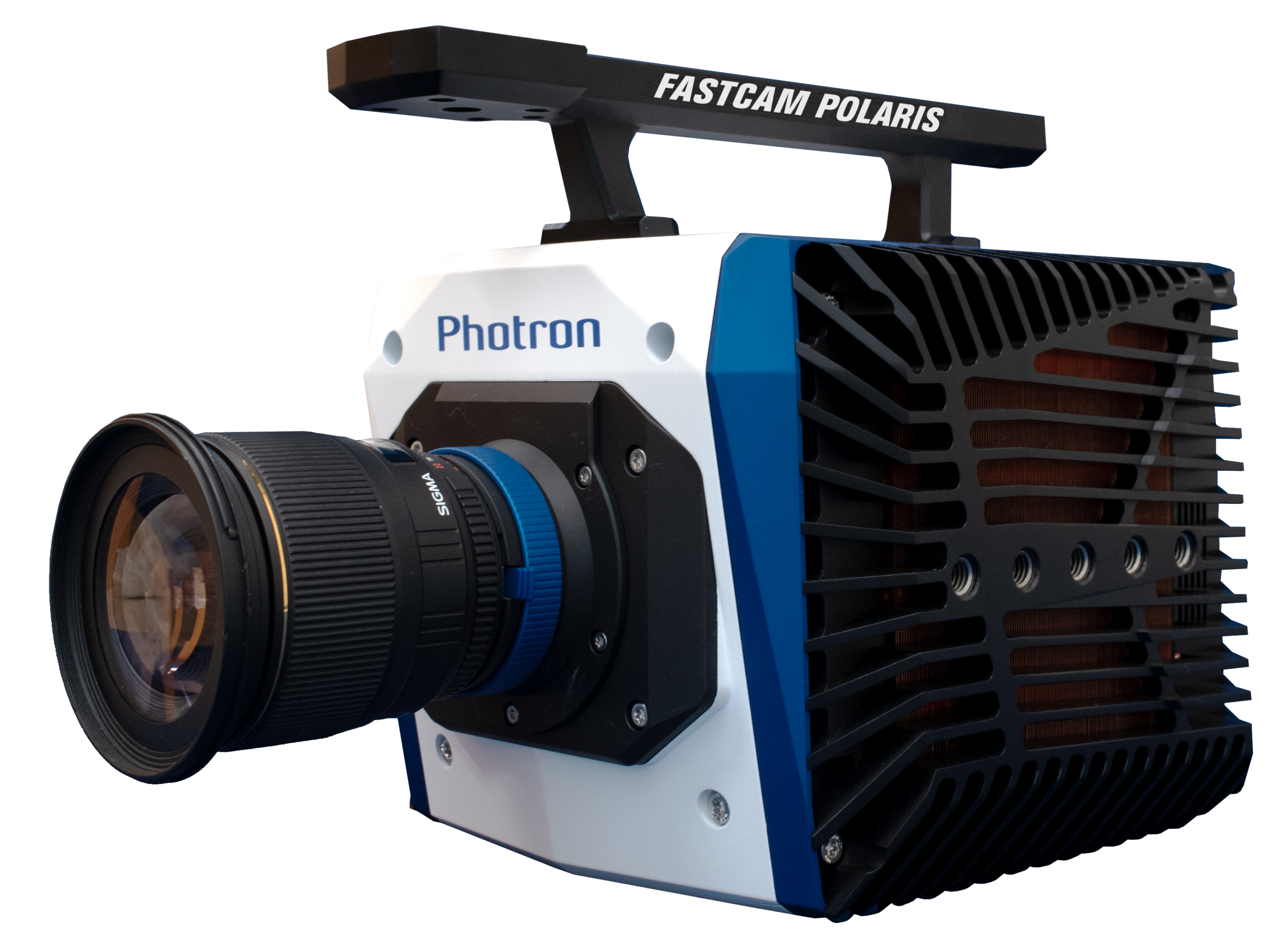
Introducing FASTCAM POLARIS F5
Discover next-generation 4K high-speed imaging with a 12-bit backside-illuminated sensor. FASTCAM POLARIS F5 captures 4,096 × 2,208 pixels at 5,000 fps; specifications and availability remain preliminary.
News & Press
Corporate announcements and press coverage from industry publications.
Photron announces the acquisition of the Swiss high-speed imaging company and outlines opportunities for technology collaboration.
Third-party business coverage of the transaction and Photron’s expanded high-speed imaging portfolio.
Photron in the Publications
Industry features and technical articles published in leading aerospace and automotive publications.
Engineering at Mach Speed
By Jennifer Fenlason. How ultra-high-speed imaging reveals shockwaves, propulsion events, structural behavior and other fast aerospace phenomena.
Read published articlePhotron: Capturing Every Perspective
A Photron-contributed feature about multi-view imaging, compact camera placement and synchronized recording in crash-test environments.
Read published articleHigh Resolution Cameras for Digital Image Correlation
By Jennifer Fenlason. An overview of high-speed imaging for material deformation and full-field strain measurement.
View publisher articleParticle Image Velocimetry
A Photron-contributed overview of choosing high-speed imaging systems for particle image velocimetry.
View publisher articlePhotron: Transformative Camera Tech
An industry feature exploring FASTCAM Orion, BSI sensor technology and correlated double sampling in combustion research.
Read published articlePhotron: High-Speed Automotive Imaging
A contributed overview of FASTCAM MH6 multi-head systems and Mini W cameras for crash testing and component analysis.
Read published articleAcademic Research Using Photron
Open-access studies highlighting Photron high-speed cameras and polarization imaging technologies.
New Research Explores How Flow-Induced Micellar Structures Influence Fluid Drag
Research Spotlight | November 2026
High-speed imaging and polarization measurement technologies help researchers investigate complex fluid behavior and the mechanisms behind drag enhancement and reduction.
Understanding how fluids behave under different flow conditions is essential to improving industrial processes, fluid transport, and material development. New research from the Massachusetts Institute of Technology (MIT) and Brandeis University explores how microscopic structures formed within certain fluids can dramatically change their resistance to flow.
The study, Tuning Fluid Frictional Drag Through Flow-Induced Aggregation of Wormlike Micelles, investigates how self-assembling surfactant molecules influence fluid friction under laminar and turbulent conditions.
Using advanced rheological measurements, high-speed imaging, and polarization-based visualization, researchers examined how changes in molecular organization affect the flow behavior of these complex fluids.
Understanding the Role of Wormlike Micelles
Wormlike micelles are flexible, elongated structures formed when certain surfactant molecules assemble in solution. Unlike conventional polymers, these structures can break apart and reassemble, allowing them to respond dynamically to changing flow conditions.
The researchers studied solutions containing trimethyltetradecylammonium chloride (TTAC) and sodium salicylate (NaSal), focusing on how their molecular structures respond to increasing shear rates and turbulence.
The study revealed that flow-induced micellar aggregation can produce dramatically different effects depending on the fluid composition and flow conditions.
Key findings include:
- Up to 50% increase in viscous drag in laminar flows at high shear rates.
- More than 200% increase in turbulent drag under certain conditions as flow-induced structures disrupt stable vortex patterns.
- Up to 30% reduction in fluid frictional drag at higher Reynolds numbers, demonstrating the potential for surfactant-based drag modification.
These results illustrate how fluid resistance can be influenced by controlling molecular interactions, surfactant concentration, and operating conditions.
The Role of High-Speed Imaging and Polarization Measurement
Capturing the behavior of complex fluids requires more than conventional measurement techniques. High-speed imaging enables researchers to observe rapid changes in fluid shape and motion, while polarization imaging provides insight into internal structural changes that may not be visible through standard imaging.
In this investigation, the researchers used a Photron NOVA P16 high-speed camera to record the evolution of thin liquid filaments during capillary-driven extensional rheology experiments. By analyzing changes in filament diameter over time, the team characterized the fluid's stretching and thinning behavior.
The study also incorporated a Rheo-Iris rheo-polarizing imaging system, combining an Anton Paar rheometer with a CRYSTA PI-5WP polarization camera. This configuration allowed researchers to investigate flow-induced birefringence and observe changes associated with molecular alignment during shearing.
The combination of mechanical measurements and optical visualization provided complementary information about how microscopic structures develop and influence macroscopic fluid behavior.
The paper also acknowledges Andrew Bridges of Photron for assistance with the commissioning, installation, and interpretation of measurements collected using the Rheo-Iris/MCR-703 system.
Implications for Fluid Dynamics and Material Research
The ability to modify fluid friction through molecular self-assembly has important implications for the study of non-Newtonian fluids and turbulent flow.
Traditional drag-reduction approaches frequently rely on high-molecular-weight polymers, which can undergo irreversible mechanical degradation under prolonged exposure to strong shear.
In contrast, the surfactant-based solutions investigated in this study demonstrated sustained drag-reduction behavior without the irreversible chain degradation associated with those polymer additives.
Although additional research is needed to translate these findings into specific industrial applications, the results contribute to a deeper understanding of fluid transport, rheology, and the development of materials with controllable flow properties.
Advancing Research Through High-Speed Visualization
This research demonstrates the value of combining advanced measurement techniques with high-speed imaging and polarization visualization to investigate complex fluid behavior.
Photron's high-speed imaging and polarization measurement technologies support scientists and engineers working across fluid dynamics, rheology, material science, and other fields where understanding rapid physical changes is essential.
Tuning Fluid Frictional Drag Through Flow-Induced Aggregation of Wormlike Micelles
Authors: Lucas Warwaruk, Amanda Tiano, Berith Isaac, and Gareth H. McKinley
Institutions: Massachusetts Institute of Technology and Brandeis University
Year: 2026
Read the full research paper (PDF)Interested in learning more about high-speed polarization imaging and rheological visualization? Explore Photron's Polarization Imaging Systems to discover technologies for advanced scientific research.
Explore Published Research
Peer-reviewed research using Photron imaging equipment across fluid dynamics, aerodynamics, biomechanics, plasma research, and manufacturing.
Sensor-Based Assessment of Trunk–Lower Limb Neuromuscular Coordination During Flat Tennis Serve
Researchers synchronized high-speed video and electromyography to examine movement phases and muscle activation during tennis serving.
An Optimized Image-Processing Algorithm for Measurement of Attached Cavities in High-Speed Flow
A cavitation-imaging study proposes a semi-automated method for measuring attached cavities around a hydrofoil.
Quantitative Evaluation of an Industrial Robot Tool Trajectory Deviation Using a High-Speed Camera
Researchers used FASTCAM imaging to evaluate and compare industrial robot tool-path deviations.
Droplet Impact on Plasma Surfaces: An Interplay of the Four States of Matter
Researchers captured droplet-impact dynamics using synchronized infrared imaging and a Photron high-speed camera.
On-Road Vehicle Aerodynamics with a Large-Scale Stereoscopic-PIV Setup: “The Ring of Fire”
A large-scale automotive flow-measurement experiment used Photron cameras to investigate the wake of a moving vehicle.
How Channel Elasticity Enhances and Directs Flow in Dendritic Microfluidic Networks
Microfluidic experiments used high-speed particle imaging to study how flexible channel structures influence flow.
Photron Newsletters
Read the latest Photron news, product updates, application stories, and research highlights.

Stay connected with Photron.
Contact our team for information about Photron high-speed imaging products, applications, published research, and upcoming developments.